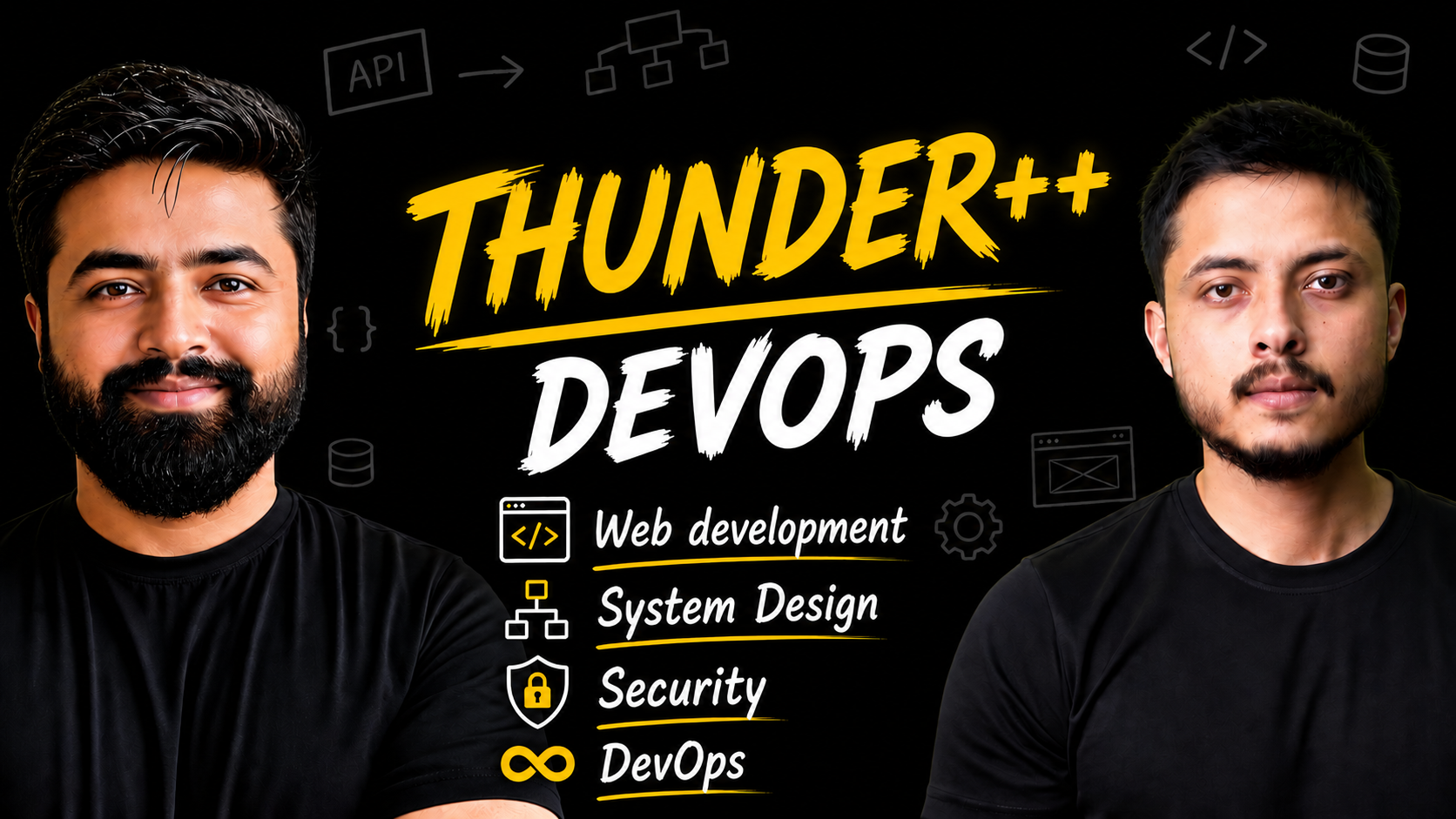
Web Development + System Design + Security + Devops (New)
PRICE
$60.64
$91.54
33.76% off
Description
Web Development + System Design + Security
Prerequiste: HTML and CSS
Course start date 1 June 2026
Class timing: 9pm (Mon,tue,thu and Fri)
Class duration: 2 Hours
Live class, recording will also be provided.
PHASE 1: JavaScript Mastery
Module 1: Introduction to JavaScript
- Introduction to JavaScript
- Role in Web Development
- State of JavaScript in 2026
- Future Scope of JavaScript
- JavaScript Engine vs Runtime
- Introduction to V8 JavaScript Engine
- How JavaScript Code Executes.
Module 2: JavaScript Fundamentals
- Hello, World Program
- Comments in JavaScript
- Variables (
var,let,const) - Primitive Data Types
- Operators
- Arithmetic, Comparison, Logical, Assignment
- Type Coercion
- Introduction to Memory (Stack vs Heap – basic idea)
Module 3: Control Flow
- Conditional Statements
if-elseswitch- Ternary Operator
- Loops
forwhiledo-while
- Break and Continue
Module 4: Functions and Execution Context
- What is a Function
- Function Declaration, Expression, Arrow Functions
- Parameters and Arguments
- Return Values
- Default and Rest Parameters
- Execution Context
- Global Execution Context
- Function Execution Context
- Creation Phase and Execution Phase
- Hoisting
- Scope
- Global, Function, Block Scope
Module 5: Call Stack and Closures
- Call Stack
- Stack Frames
- Function Invocation Flow
- Closures (Introduction)
- Closures with Memory Reference
- Practical Use Cases of Closures
Module 6: Data Types Deep Dive
- Strings
- Arrays
- Array Methods (
map,filter,reduce, etc.) - Iteration Techniques
- Array Methods (
- Objects (Basics)
- Date and Time
Module 7: Objects in JavaScript
- Object Properties and Methods
- Object References and Copying
- Optional Chaining
- JSON (JavaScript Object Notation)
- Symbol Data Type
Module 8: Modern JavaScript (ES6+)
- Template Literals
- Destructuring (Arrays and Objects)
- Spread and Rest Operator
- Default Parameters
- Modules (
import/export) - Maps and Sets
- WeakMap and WeakSet
Module 9: Object-Oriented JavaScript
- Introduction to OOP
- Classes and Objects
- Constructors
thisKeyword (Basics)- Prototypal Inheritance
- Encapsulation (Private Fields)
- Polymorphism
Module 10: Asynchronous JavaScript
- Synchronous vs Asynchronous Execution
setTimeoutandsetInterval- Callbacks
- Callback Hell
- Promises
- Promise Chaining
asyncandawait- Error Handling using
try-catch
Module 11: Event Loop and Async Internals
- JavaScript Single Thread Model
- Web APIs (Browser Environment)
- Callback Queue (Task Queue)
- Microtask Queue
- Event Loop
- Microtask vs Macrotask
- Execution Order Deep Dive
Module 12: DOM Manipulation
- DOM Introduction
- DOM Tree
- Selecting Elements
- Updating Content
- Adding and Removing Elements
Module 13: Event Handling
- Browser Events
- Event Listeners
- Event Bubbling and Capturing
- Event Delegation
- Prevent Default
- Stop Propagation
Module 14: Network Requests and Advanced Concepts
- HTTP Basics
- Fetch API
- Handling API Responses
- Error Handling in Requests
- CORS (Cross-Origin Requests)
- Deep Dive into
thisKeyword call,apply,bind- Advanced Error Handling
- Custom Errors
- Introduction to Garbage Collection
- High-Level Optimization in V8 JavaScript Engine
10 Projects on javascript
Phase2: Backend Mastery
Module 1: Backend Fundamentals and Node.js Introduction
- What is Backend Development
- Client-Server Architecture
- Need for JavaScript on Server
- Introduction to Node.js
- How Node.js runs JavaScript
- Event-driven and Non-blocking nature
Module 2: Node.js Basics
- Running JavaScript outside the browser
- Global objects (
process,__dirname, etc.) - Modules in Node.js
- CommonJS (
require,module.exports)
- CommonJS (
- Creating a basic project structure
Module 3: Core Node.js (Only What You Need)
- File System (
fs)- Reading files
- Writing files
- Understanding async vs sync code in Node.js
- Intro to Streams (very basic intuition)
Module 4: Building Your First Server
- Creating HTTP server using Node.js
- Request and Response objects
- Handling routes manually
- HTTP Methods
- GET, POST, PUT, DELETE
- Sending JSON data
Limitation discussion:
- Why raw Node.js is painful → leads to Express
Module 5: Introduction to Express.js
- Why Express.js
- Setting up Express server
- Basic routing
- Handling requests and responses
- Sending JSON
Module 6: Routing and Middleware
- Route parameters
- Query parameters
- Middleware concept (very important)
- Built-in middleware (
express.json) - Custom middleware
- Request lifecycle in Express
Module 7: REST API Development
- REST principles (practical, not theory heavy)
- CRUD operations
- Designing endpoints
- Handling request body
- Status codes (important ones only)
- Centralized error handling
Module 8: MongoDB Basics
- Why database is needed
- SQL vs NoSQL (quick comparison)
- Introduction to MongoDB
- Collections and Documents
- Basic CRUD operations
Module 9: MongoDB with Mongoose
- Introduction to Mongoose
- Creating schemas and models
- CRUD using Mongoose
- Data validation
- Simple relationships
Module 10: Authentication (Core Only)
- Authentication vs Authorization
- User signup and login flow
- Password hashing using bcryptjs
- JWT basics
- Protecting routes using middleware
Module 11: File Uploads (Practical Feature)
- Handling file uploads using Multer
- Storing files locally
- Returning file URLs
Module 13: AI Integration
- What is LLM
- Vector Database
- Integrating AI
- AI Agent
Projects
Phase 3: System Thinking and Backend Scaling Basics
Module 1: Introduction to System Thinking
- What is System Design (practical meaning)
- Difference between coding vs designing systems
- Understanding scale (users, requests, data)
- Latency vs Throughput (intuition only)
- Monolith vs Microservices (high level overview)
Module 2: Backend Performance Basics
- What happens when traffic increases
- Identifying bottlenecks
- CPU
- Memory
- Database
- Introduction to horizontal vs vertical scaling
- Why naive backend breaks under load
Module 3: Rate Limiting (Core Concept + Implementation)
- What is Rate Limiting and why it is needed
- Real-world use cases (login, APIs, payment endpoints)
- Types of Rate Limiting
- Fixed Window
- Sliding Window (basic idea)
- Implementing Rate Limiting in Express.js
- Using middleware for rate limiting
- Intro to tools like Redis (conceptual, optional)
Module 4: MongoDB Architecture Basics
- How MongoDB works internally (high level)
- Collections, Documents, Indexes revisited
- What are Indexes and why they matter
- Query performance basics
- Replication (primary-secondary concept)
- Sharding (very basic intuition, no deep dive)
- When MongoDB becomes slow and why
Module 5: Caching Fundamentals
- What is caching
- Why caching improves performance
- Where to use caching
- API responses
- Database queries
- Intro to Redis
- Cache invalidation problem
Module 6: Real-Time Systems with WebSockets
- Why HTTP is not enough for real-time apps
- Polling vs WebSockets vs SSE (high level)
- Introduction to WebSockets
- How WebSocket connection works internally (upgrade request)
- Building real-time features using Socket.IO
- Sending and receiving real-time data
- Handling multiple clients
Module 7: System Design Thinking (Applied Basics)
- Breaking a feature into components
- Designing APIs for a feature
- Handling data flow between client and server
- Basic fault tolerance thinking
- Simple scalability decisions
- Build one project
Phase 4: Advanced System Design (Internals + HLD)
Module 1: Advanced System Design Foundations
- Revisiting scalability with real numbers (RPS, storage, bandwidth)
- Latency vs Throughput (quantitative understanding)
- Availability vs Consistency (practical trade-offs)
- CAP Theorem (applied, not theoretical)
- Identifying bottlenecks in large-scale systems
Module 2: Core Architecture Components (Deep Understanding)
- API Gateway (routing, authentication, aggregation)
- Load Balancers
- L4 vs L7
- Algorithms (Round Robin, Least Connections, IP Hash etc)
- Reverse Proxy
- Stateless vs Stateful services
- Service-to-service communication (sync vs async)
Module 3: Database Scaling
- Database Replication
- Master-Slave Architecture
- Database Sharding
- Consistent Hashing
- Problem with traditional hashing
- Hash ring
- Node addition/removal
- Load distribution
- Use in caching and distributed systems
- Eventual Consistency
- Gossip Protocol and Merkle Tree
- Leader Election and Distributed Coordination
- Data Backups and Disaster Recovery
Module 4: Database Internals (MongoDB Focused)
- Internal working of MongoDB
- Storage engine (high level)
- Indexing deep dive
B+ Tree
- Why B+ Tree is used in databases
- Disk-based access optimization
- Structure and traversal
- Search complexity
- Range queries efficiency
- Query execution using indexes
- Read vs write trade-offs
- Replication and sharding (internal reasoning)
Module 5: Searching Systems and Elastic Search
- Why databases fail for search use cases
- Introduction to Elastic search
Inverted Index
- Concept and structure
- Tokenization and indexing
- Mapping terms to documents
- Query phase vs indexing phase
- Ranking and relevance (intuition)
- Distributed search
- Shards and replicas
- Syncing DB with search engine
Module 6: Caching and Distributed Caching
- Revisiting caching at scale
- Cache strategies (deep)
- Cache invalidation challenges
- Internals of Redis (high level)
- Data eviction strategies (LRU, LFU, FIFO etc)
Module 7: Messaging Systems and Kafka Internals
- Why messaging systems are required
- Queue vs Pub/Sub model
- Introduction to Apache Kafka
Kafka Internals
- Topics and partitions
- Producers and consumers
- Consumer groups
- Offset management
- Message ordering guarantees
- Log-based storage system
- Partitioning strategy
- Fault tolerance and replication
- Why Kafka is highly scalable
Module 8: Advanced Rate Limiting
- Revisiting rate limiting at scale
Algorithms (Deep)
- Fixed Window
- Sliding Window
- Token Bucket
- Leaky Bucket
- Distributed rate limiting challenges
- Storing counters in cache/datastore
- Designing rate limiter for real systems
Module 9: System Design Patterns
- Microservices vs Monoliths
- Strangler pattern
- Decomposition by Business Logic
- Decomposition by Sub-Domains
- SAGA Pattern
- Choreography-based
- Orchestration-based
- CQRS Pattern (Command Query Responsibility Segregation)
- Circuit breaker pattern
Module 10: Modern Design Infrastructure
- Content Delivery Networks (CDN)
- Object Storage (S3-like systems)
- Media Processing Pipelines
- Search Systems
- Recommendation Systems
Module 11: Observability and Debugging
- Logging systems
- Metrics and monitoring
- Distributed tracing (basic idea)
- Debugging production systems
Module 12: Security in System Design
- Secure system architecture
- Authentication vs Authorization at scale
- API protection strategies
- Rate limiting as a security layer
- Handling common attack patterns (high level)
Phase 5: Frontend Development (React, TypeScript, Tailwind)
Module 1: Frontend Architecture and React Introduction
- Role of frontend in full-stack systems
- SPA vs MPA
- Why React
- Virtual DOM
- Project setup (Vite)
- Folder structure
Module 2: React Fundamentals
- JSX
- Functional Components
- Props
- Conditional Rendering
- Lists and Keys
- Event Handling
Module 3: State and Component Thinking
- What is state
useState- Controlled vs uncontrolled components
- Lifting state up
- Component communication
Module 4: Side Effects and Data Fetching
useEffect- Dependency array
- API calls
- Cleanup
- Common mistakes
Module 5: Advanced Hooks
useRefuseMemouseCallback- Custom hooks
- Optimization basics
Module 6: Routing
- Introduction to React Router
- Dynamic routes
- Protected routes
- Navigation patterns
Module 7: API Integration and Auth Flow
- Connecting to backend APIs
- Handling loading and error states
- JWT flow (login/logout)
- Token storage basics
Module 8: Introduction to TypeScript
- Why TypeScript
- Basic types
- Interfaces vs types
- Functions with types
- Type inference
Module 9: TypeScript with React
- Typing props
- Typing hooks
- Forms and events
- API response typing
- Common pitfalls
Module 10: Styling with Tailwind CSS
- Introduction to Tailwind CSS
- Utility-first approach
- Layout (flex, grid)
- Responsive design
- Reusable UI components
Module 11: State Management (Redux and Alternatives)
Why Global State?
- Problem with prop drilling
- When local state fails
Introduction to Redux
- Core concepts
- Store
- Actions
- Reducers
Using Redux Toolkit
- Why Redux Toolkit simplifies Redux
- Creating slices
- Configuring store
- Dispatching actions
- Accessing state with hooks
Async State Management
- Handling API calls with Redux
- Loading, success, error states
Alternatives (Important for maturity)
- Context API (when to use)
- Why not always Redux
Module 12: Forms and Validation
- Controlled forms
- Form validation
- Error handling
- UX best practices
Module 13: Performance Optimization
- Re-rendering behavior
- Memoization
- Lazy loading
- Code splitting
Phase 6: Capstone Projects
Project 1: Cloud Video Storage System (S3-like)
What You Will Build:
- Video upload system (large file handling)
- Secure access using presigned URLs
- Video processing pipeline (basic transcoding workflow)
- Video streaming system (HLS-based playback)
- Storage and metadata management
- Basic CDN-style delivery (conceptual)
Tools & Technologies:
- Backend: Node.js, Express.js
- Database: MongoDB
- Caching: Redis
- Messaging / Queue: Apache Kafka
- Streaming: HLS (implementation level)
- Frontend: React + TypeScript + Tailwind CSS
Project 2: Quick Commerce Platform (Blinkit-style + AI)
What You Will Build:
- Full e-commerce flow (products, cart, orders)
- Real-time rider tracking on map
- Order lifecycle management (state machine)
- Inventory and product management
- Search and filtering system
- Multi-channel notification system
AI Features:
- AI-powered product recommendations
- Semantic product search using vector embeddings
- AI agent for user assistance (chat/query handling)
Tools & Technologies:
- Backend: Node.js, Express.js
- Database: MongoDB
- Caching: Redis
- Real-time: WebSockets
- Messaging: Apache Kafka
- Search: Elasticsearch
- Vector Search: Vector DB (for embeddings-based search)
- AI Integration: LLM APIs / AI agent framework (basic usage)
- Frontend: React + TypeScript + Tailwind CSS + Redux Toolkit
Phase 7: Deployment and Production Setup
Good catch — without Nginx + HTTPS (TLS) your deployment phase is incomplete.
Right now you’re teaching “how to deploy”, but not “how production systems actually serve traffic securely”.
Let’s upgrade Phase 7 properly, without bloating it.
Phase 7: Deployment and Production Setup (Final)
Module 1: Version Control (Git and GitHub)
- Introduction to Git
- Branching, merging, conflicts
- Introduction to GitHub
- Collaboration workflow
Module 2: Environment and Configuration
- Environment variables (
.env) - Secrets management
- Dev vs Production setup
Module 3: Containerization
- Introduction to Docker
- Dockerfile
- Containerizing backend and frontend
- Running full-stack apps in containers
Module 4: Deployment Fundamentals
- What happens when you “deploy”
- Frontend vs Backend deployment
- Domains, DNS basics
- Build process
Module 5: Backend Deployment (AWS)
- Deploying Node.js app on Amazon Web Services
- EC2 basics (virtual server)
- Running server in production
- Connecting database
Module 6: Web Server and Reverse Proxy (Critical)
- What is a web server
- Why we don’t expose Node.js directly
- Introduction to Nginx
- Reverse proxy concept
- Routing traffic to backend
- Serving static frontend files
- Load handling basics
Module 7: HTTPS and Security (TLS)
- Why HTTP is not secure
- What is HTTPS
- Introduction to TLS (encryption basics)
- SSL/TLS certificates
- Setting up HTTPS using Let's Encrypt
- Auto-renewal of certificates
- Securing APIs and frontend
Module 8: Frontend Deployment
- Building React app
- Hosting frontend
- Connecting frontend with backend over HTTPS
No records found
Loading...
No test series found
$60.64